I've always contended that there are a number of people gaming the KDP system. Today I'll offer evidence of it.
You can make yourself look very good if you have a few hundred, or even a few thousand bucks, to spare by going to the store and buying "gift" credit cards and then use them to buy your own books after lowing the price to 99 cents (or free) and then leave yourself reviews with a credit card that isn't linked to your real name. You can register a gift card under any fake name, phone #, and address you like. Then Amazon has no way of knowing who you really are, and they'll accept your reviews of your own books. Kid's stuff-101, right?
WHAT TO WATCH FOR
The vast majority of mainstream authors will sell about as many print books as they do Kindle books. Providing the Kindle and print editions come out around the same time, their sales rankings will be pretty close. Hardback sales usually take a nosedive after the print/kindle edtions come out, so you generally can't count those. However, sometimes the Kindle edition will come out while the hardback is still selling well and there isn't yet a paperback edition, or if there is one, it's something like a large print edition or a mass produced edition if it's a classic, and those don't sell very good. In that case, the Kindle and hardback editions may rank very close in sales. A good example is Bill O'Reilly's Killing Lincoln. The only paperback edition of that book is a large print edition, so it doesn't sell well at all. But look how close the hardback and Kindle eidtions are in sales ranking:
Hardback - 60 # ranking
Kindle - 174
Here's an example of someone I won't name, but it's a self-published author who sells extremely well through Kindle books, but look at their Createspace paperback sales ranking of the same book which has been out for a couple of years now:
Paperback - 1,365,020
Kindle - 1,352
Now let's look at a book by a good traditional author. Fitzgerald's The Great Gatsby is on the best seller's list again because of the new movie coming out.
Paperback - 17
Kindle - 144
Lady Almina and the Real Downton Abbey: The Lost Legacy of Highclere Castle by the The Countess Of Carnarvon is big because of the PBS Downtown Abbey series:
Paperback - 38
Kindle - 461
If someone self-published uses KDP (Kindle books) & Createspace (or Lulu) and has their book(s) available in both Kindle and print editions, and they're a big seller, then their sales rankings should run close to the same in both Kindle and print since the buying public purchases about as many Kindle books as print books right now. (Actually, paperback sales are generally still a bit higher.) If you see a large descrepency, between the two, you can bet it's probably somebody gaming the system. After all, it's cheap for someone with a good job to spend a thousand dollars on gift cards in order to produce sales and phoney reviews by just lowering the price on their Kindle books now and then use gift cards to spend a dollar on each in order to make a few purchases and leave reviews, and then raise the price back up the next morning. But how do they do the same with print books without loosing their shirts? They can't. The Kindle books didn't cost them anything to make or sell. But they can't lower the price of print books below a threshhold that covers all the costs of it, and that isn't cheap, so gaming the system with print books is very difficult unless you're very rich.
The gist of things is this: If Kindle sales rankings are very high, and print sales rankings are very low, there's reason for concern.
Showing posts with label Kindle. Show all posts
Showing posts with label Kindle. Show all posts
Thursday, January 31, 2013


Thursday, November 3, 2011
E-Reader Pros & Cons
I think e-readers are great mostly, but they do have their downside. Here are the most important pros and cons pertaining to the majority of e-readers.
Pros:
1) Your heavy 1000-page epic like War & Peace weighs no more than any other book on an e-reader.
2) You can store thousands of books on one.
3) You can still underline and make notations just like on hard copy.
4) Some e-readers like the Kindle-3 have a text to speech converter with a computer generated voice that will read most books to you through the built-in speaker if you want to listen to your books as audio books.
5) You can jump straight to chapters and endnotes by clicking on their number if they've been properly hyperlinked and then just hit the back button to return.
6) You can bookmark pages (Kindle even shows a little dog-eared icon at the top of a bookmarked page) and jump straight to them and back again from anywhere in the text.
7) Kindle and others have built-in dictionaries. Don't know what a word means? Just move your cursor to it and the definition will automatically pop-up.
8) Batteries in e-readers last for weeks without a recharge providing you keep the wireless feature turned off when not in use and actually turn the reader off instead of on standby when you're done reading.
9) You can make folders and use them any way you desire. You could for instance just have a separate folder for each author, or you could have a folder for each genre and then sub folders for the authors etc.
10) You can make the text as big or small as you like.
Cons:
1) At this point e-readers have not used page numbers. Because the reader is free to change the text size, page numbers are a problem. For authors doing research and who plan on using quotes for books they're writing, it's difficult to footnote the page number when you don't have it available! This could really become quite a dilemma in the future as more and more books are being released as e-text only. At least an e-reader will tell you a percentage of where you are at in a given book (whether you're 25% of the way into it or 40% etc.).
2) For those designing e-books, there are limitations that must be worked around such as available fonts and so on. It’s not always possible to make the text in an e-reader look exactly the same as that in a hard copy book.
3) Books on Mathematics must be shown as PDF files because the text size must stay the same when showing equations so that they don’t break apart, and PDF files are difficult to read on e-readers since you might have to magnify the entire page to make it large enough to read, and then you may be in for some side to side scrolling.
4) There is no standard format across all e-readers as of yet. Actually, most do use epub, but Amazon's Kindle is the holdout using the AZW format (based on mobi format). Other e-readers can't read AZW, and the Kindle can't read epub. So, some books may not be available for download in the format you need for your particular reader.
5) E-books are often digitally encrypted and therefor difficult to copy. This means that you can't always share an e-book with a friend the way you can a hard copy book, nor give them away or resell them. In fact, it's often been said that you don't really own an e-book—you just buy the rights to read it. However, books downloaded through Amazon generally give the reader the privilege of sharing the book with one person. Also, for those with the savvy to do it, any e-book's encryption can be broken.
6) You can't flip through pages quickly the way you can with a hard copy book.
7) Some e-books even from big publishers are poorly formatted with spaces between paragraphs, no indents, and no hyperlinks for the foot/endnotes. I've even come across some (especially free books at Gutenberg) that didn't even bother hyperlinking the chapters, and without a navigable TOC (table of contents) it can be tough maneuvering through an e-book unless you plan to read it straight through.
8) Free e-books at sites like Gutenberg often have several errors in them. Everything from misspelled words to missing words and misplaced punctuation.
The majority of the time I can download books through Amazon or free ones at Gutenberg and have no problems at all with them. But there are times that it’s challenging, especially with the free ones. However, for me, the pros definitely outweigh the cons.
Pros:
1) Your heavy 1000-page epic like War & Peace weighs no more than any other book on an e-reader.
2) You can store thousands of books on one.
3) You can still underline and make notations just like on hard copy.
4) Some e-readers like the Kindle-3 have a text to speech converter with a computer generated voice that will read most books to you through the built-in speaker if you want to listen to your books as audio books.
5) You can jump straight to chapters and endnotes by clicking on their number if they've been properly hyperlinked and then just hit the back button to return.
6) You can bookmark pages (Kindle even shows a little dog-eared icon at the top of a bookmarked page) and jump straight to them and back again from anywhere in the text.
7) Kindle and others have built-in dictionaries. Don't know what a word means? Just move your cursor to it and the definition will automatically pop-up.
8) Batteries in e-readers last for weeks without a recharge providing you keep the wireless feature turned off when not in use and actually turn the reader off instead of on standby when you're done reading.
9) You can make folders and use them any way you desire. You could for instance just have a separate folder for each author, or you could have a folder for each genre and then sub folders for the authors etc.
10) You can make the text as big or small as you like.
Cons:
1) At this point e-readers have not used page numbers. Because the reader is free to change the text size, page numbers are a problem. For authors doing research and who plan on using quotes for books they're writing, it's difficult to footnote the page number when you don't have it available! This could really become quite a dilemma in the future as more and more books are being released as e-text only. At least an e-reader will tell you a percentage of where you are at in a given book (whether you're 25% of the way into it or 40% etc.).
2) For those designing e-books, there are limitations that must be worked around such as available fonts and so on. It’s not always possible to make the text in an e-reader look exactly the same as that in a hard copy book.
3) Books on Mathematics must be shown as PDF files because the text size must stay the same when showing equations so that they don’t break apart, and PDF files are difficult to read on e-readers since you might have to magnify the entire page to make it large enough to read, and then you may be in for some side to side scrolling.
4) There is no standard format across all e-readers as of yet. Actually, most do use epub, but Amazon's Kindle is the holdout using the AZW format (based on mobi format). Other e-readers can't read AZW, and the Kindle can't read epub. So, some books may not be available for download in the format you need for your particular reader.
5) E-books are often digitally encrypted and therefor difficult to copy. This means that you can't always share an e-book with a friend the way you can a hard copy book, nor give them away or resell them. In fact, it's often been said that you don't really own an e-book—you just buy the rights to read it. However, books downloaded through Amazon generally give the reader the privilege of sharing the book with one person. Also, for those with the savvy to do it, any e-book's encryption can be broken.
6) You can't flip through pages quickly the way you can with a hard copy book.
7) Some e-books even from big publishers are poorly formatted with spaces between paragraphs, no indents, and no hyperlinks for the foot/endnotes. I've even come across some (especially free books at Gutenberg) that didn't even bother hyperlinking the chapters, and without a navigable TOC (table of contents) it can be tough maneuvering through an e-book unless you plan to read it straight through.
8) Free e-books at sites like Gutenberg often have several errors in them. Everything from misspelled words to missing words and misplaced punctuation.
The majority of the time I can download books through Amazon or free ones at Gutenberg and have no problems at all with them. But there are times that it’s challenging, especially with the free ones. However, for me, the pros definitely outweigh the cons.
Saturday, October 8, 2011
Review: SD Tabletwear Lighted Case For Kindle

As e-readers are becoming more and more prolific, so too are accessories for them. Just a couple of years ago there were only a couple of lighted covers to choose from for your Kindle. Now there are close to a dozen, albeit most covers that come with a light are very expensive. Today I’ll be reviewing one from SD Tabletwear—a very inexpensive alternative that’s still very high quality and extremely stylish.
I should say up front that I’m not sure who actually manufactures this case. The Kindle Cover I received for review is distributed by Slick Distributions LTD and is sold under the name Luminous in the UK by GearZap. (They have a second online distributive channel called mobilefun.co.uk which sells the same case for the same price.) This case is also distributed in the USA by AYL® (A Young Life). Americans can, however, buy the case through GearZap.com also. They currently sell it for £19.95 which I believe amounts to roughly $30 American currency. Amazon’s own lighted cover for Kindle (which I reviewed here) sold for $60 originally. They now have the price down to $50. That’s still $20 more than the lighted cover I’ll be reviewing today.
This Kindle Cover with Light is made from polyurethane leather—basically a low to mid grade leather with a polyurethane poured over it. The result is an inexpensive leather that will now be stronger and more resistant to abrasions and weather (because of its low water absorption) than the highest grades of leather. Adidas Roteiro soccer balls, for instance, and several manufacturers of high quality automobile seats are covered with the same material. The case feels very strong and yet soft to the touch.

The inside is covered with a beautiful soft velvet in your choice of red or purple.

If there was any glue used on the case, I’ve not been able to spot it. Everything I see is well stitched together.

There’s also a convenient strap to carry the case with. It’s made of the same polyurethane leather and is easily detachable if not needed. The case is secured by a tab that slides under a loop on the rear of the case.

If you want to fold the case in half while reading, you can attach the tab backwards through that same loop on the back of the case to keep it from flapping around.
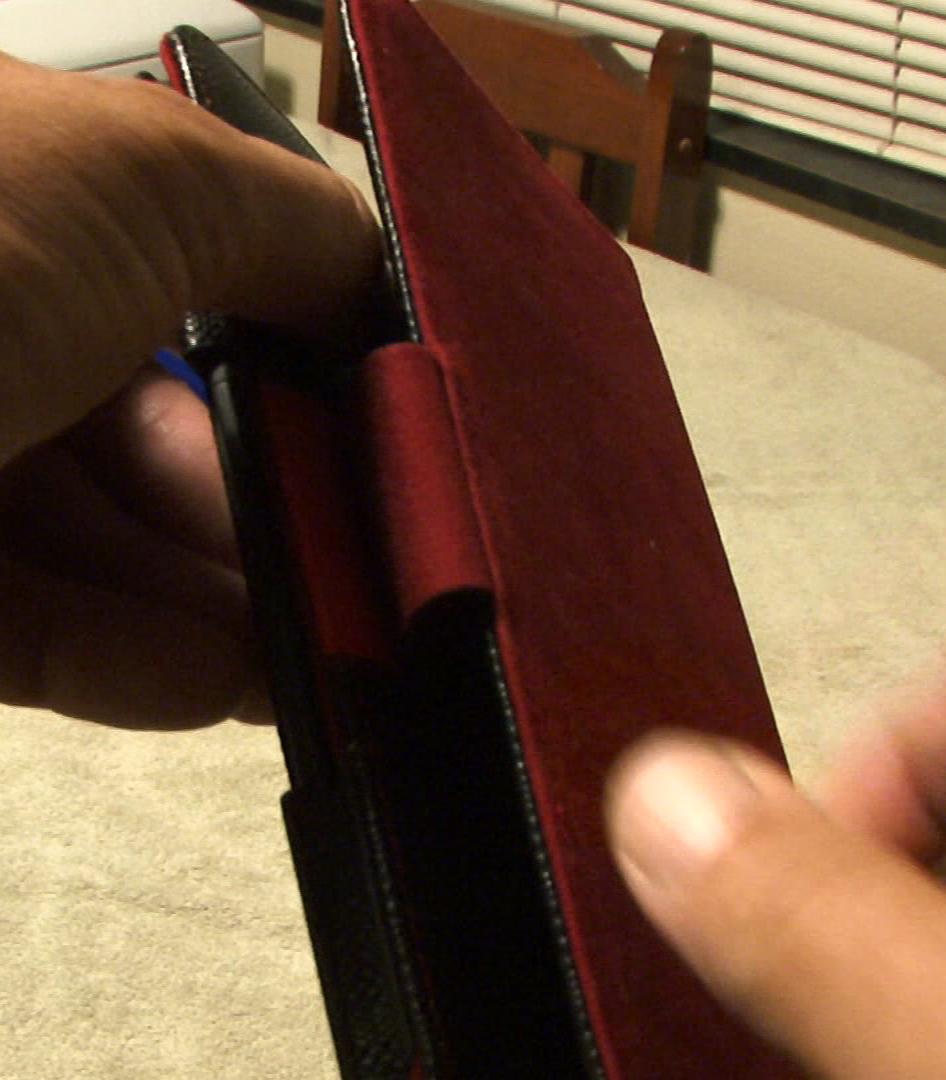
Your Kindle will slide into the straps snug and secure with no danger of falling out. And the design allows you full access to all the Kindle’s controls. Once you’ve placed the Kindle in this case, it’s unlikely you’ll ever have a reason to remove it. It’s as snug as a bug in a rug!


As well-made as the case is, the light may even be better. The machining on this light is as good as it gets with every part well-seated.

It sports a single white light LED (daylight temperature) which is very easy on the eyes. There’s also a diffuser to aid in getting rid of glare.


It uses 3 AG13 1.5V Button Cell Batteries. These are rated at no less than 25-hours of use and are very economical. You can buy them in packs of ten for less than a quarter each and in packs of fifty for about a dime.

You can keep the light in a drawer if you don’t use it much, but the case also has an elastic band for storing the light. There’s even a small hole to allow for easy access to the light’s on/off button.

I did find myself accidentally turning the light off and on with the case folding in half while reading since this makes the button stick right out into your hand; however, you’ll be glad to know that you can simply turn the light so that the button is pointing elsewhere with no problem. In fact, you can just as easily press the button through the fabric holding it in place, so there’s really no problem at all in this regard.

You may even find that there’s no need to ever remove the light from its elastic holding strap. The base of the light is magnetic, and there’s a magnet on the upper right corner of the case to hold it while reading.

However, I found that keeping the light in its holder, and then bending the gooseneck to the side, provided excellent illumination, perhaps even better than when placed on the magnetic holder.

That flexible gooseneck is what really sets this light apart from most others in the e-reader marketplace. You can easily find a position which illuminates the entire screen evenly. You may recall from my review of Amazon’s own lighted case that getting even light distribution was a major problem with theirs because the bottom half of the screen got very little light in comparison to the upper half.
My photo here doesn’t do the light justice as I couldn’t manage to photograph it in such a way that shows even light distribution, but believe me, you can do it.

Conclusions:
Don’t get me wrong, although it's close, no one has yet to come out with the perfect lighted e-reader case. My only complaint with this one is that, while the light is sufficient, it could be a bit stronger. I’ve always believed that the best way to attack the problem is to have a case with 4-LEDs, one in each corner of the screen. I’m confident that eventually we’ll see that case appear. But at the moment, this offering from SD Tabletwear may just be the one to beat, especially considering the low price, high quality materials, great workmanship, and an adequate LED light on a gooseneck for easy positioning. My sister wants a Kindle for her birthday, and I intend to give her one of my two lighted cases to go with it. Guess which one I’ll be keeping.
Subscribe to:
Posts (Atom)