Sunday, January 22, 2012

Wasted Words

Others have written articles about the term "wasted words", but I'm going to take a different angle on them, and in doing so, will shine a light on the most annoying thing in all of literature from my perspective.

Books and articles about wasted words can sometimes do more harm than good. What they point out are examples of phrases that seem to them as lengthy or unnecessary, so they urge writers to cut them short—something often referred to as "an economy of style." The following is a list of wasted words Jack Lynch gives in his book: Guide to Grammar and Style:

  •  quite
  • very
  • extremely
  • as it were
  • moreover
  • it can be seen that
  • it has been indicated that
  • basically
  • essentially
  • totally
  • completely
  • therefore
  • it should be remembered that
  • it should be noted that
  • thus
  • it is imperative that
  • at the present moment in time

You may have noticed that five of the above examples end with the word "that." If there's a single word writers overuse, and often unnecessary so, it would probably be "that." Rather than removing the phrases listed above which have "that" at the end, we might find those phrases can exist just fine by removing "that" from them and possibly re-wording things. For instance:

"It is imperative that" would read fine by simply removing "that" from the end. No further change is necessary.

"It should be noted that" would read better written something like: "One should note" etc.

I actually agree with most of Lynch's list. The thing to be aware of is the tendency to remove too much. This economy of style notion can cause writers to write like children in short, stabby sentences if taken to extremes, and no one took it to extremes quite like Hemingway who went so far as to decide that even conjunctions were wasted words.

What I really want to talk about, however, are other kinds of wasted words and those would entail words, phrases, and whole sentences that add nothing to a story, serving only to waste the reader's time. These often take the form of unnecessary descriptions. Let's look at some examples I've gleaned from books at random.

His mother turned from the sink. She wore navy cotton slacks, a white silk blouse, and a damp checkered apron. At moments like this, harried as she was from an evening of entertaining, his mother’s advancing age suddenly struck him. Who was this gray-haired old woman in his mother’s kitchen?

This example is the only one I will give where I'll name the author, and in this case it happens to be from James Rollins' novel—The Judas Strain. The reason I don't mind naming Rollins here is because I simply want to show that even really good authors are guilty of doing this now and then. Obviously we have no need to know what this character's mother is wearing in this instance. It has no bearing on the story at all. Fortunately, you won't find much of this kind of thing in Rollins' tales. Where he sometimes does go wrong in the area of wasted words is in often telling us the brand names of products such as automobiles or food goods where the reader would be better off not knowing. The following example is not however from a Rollins book:

The blue is darker than my eyes, which are closer to azure, sky blue, but I’m not as dark as the nearly purple Chevy I drove in high school.

Telling us the model of the car this character drove in high school added nothing whatsoever to the story. Neither did we need to know the color of anyone's eyes in the tale. This is not to say that there couldn't be a situation where the reader may need to know such information, or where it might aid the reader in better knowing a character's personality, but that's seldom the case. Knowing that Jay Gatsby drove a Rolls Royce and lived in a mansion in The Great Gatsby told us a lot about his personality. Saying whether a character drove a Chevy or a Dodge in high school usually does not.

The following author has got to be the most exasperating I've ever read, and it's all because of wasted words that find their way onto every single page. Here's an example of an entirely wasted paragraph:

Prescott Stevens, president of the 1800 Club, raised the wick of the oil lamp he was reading by and picked up the TV remote next to his tea. He aimed and clicked it at the big-screen TV opposite him, and rubbed his eyes as he went to the Weather Channel 7:00 PM broadcast. After finishing the mid-west coverage, the young woman said, “. . . and in the New York, New Jersey, and in some areas of Connecticut, rain accompanied by thunder storms continue for the second straight day. It promises to let up early tomorrow.”

I can tell you from having finished the book that not one word in this paragraph was necessary to know. It comes under the heading of "useless information." It's the type of information that causes readers to skim. Anytime readers feel it's okay to skim in your book, you know you have some wasted words ready to be cut.

Here's another example from the same book:

Turning the set off, he stood and stretched to his full height of five feet seven inches and rubbed his plump stomach. He faced the full-length mirror and buttoned the vest of his three-piece brown suit then tightened a dark brown silk cravat around his starched collar, and pushed the pearl stickpin through the shirtfront. Stevens patted his short brown and gray beard and pulled and twisted the almost-full handlebar mustache until he was fairly satisfied. He pressed a button next to the large mahogany desk and was answered immediately by his butler and right-hand person, Matt.

We know within the first chapter of the book that it's a story based on time travel back and forth between present day and the 1860s. The characters who undergo time traveling obviously will change their clothing to fit in with the era in which they travel. Yet this author has decided to inform his readers about every stitch of clothing the characters wear at all times. After the first chapter you'll want to scream, "We get it already! They dress appropriately for the era. Enough with the useless descriptions and get on with the story if you have one!"

Something else to notice above is that we're told the type of wood used in the desk. The author does this type of thing repeatedly. Almost any time there's a mention of a wooden object, he tells us the type of wood. He also feels compelled to tell us the color of carpeting several times in different rooms even though the color, or whether or not there even is carpeting or wood flooring or tiles, has nothing to do with the story.

The doorman held the door open and Bill entered. He went downstairs, sliding his hand along the well-polished curved mahogany banister, and then walked on the dark brown wall-to-wall carpet. An oversized ornate wooden door with a large brass handle faced him.

All useless information!

He entered a small walk-in closet that had his name etched in a silver nameplate on the door and sat on an upholstered bench to remove his wet shoes and socks.

Just tell us he changed his clothes for Pete's sake and leave it at that.

Bill turned back to his computer and looked at the results of the subject he had punched into Google.

Just say "the subject of his search." Why do I need to know which search engine Bill used?

I read and reviewed another book not long ago for a lady friend/author that turned out to be a paranormal romance. Had I known that ahead of time I wouldn't have volunteered to read the damned thing! As you might have guessed, it was chock full of wasted words. There were several entire chapters devoted to the building of a new home to a character's specifications and details given, not only about the house from top to bottom, but even the incredibly boring meetings between the character and her architect. Once again, not one iota of this information had anything to do with the heart of the story. This is one of the few books where I felt justified in ignoring entire chapters before giving a review.

I'll leave you with a rule of thumb I lit upon earlier. When proofing your manuscript, ask yourself if anything in it can be skipped without losing anything from the story. If it can, leave it out, or risk boring your readers into putting your book down and reading something else. Every word must be important and must be the right word or phrase that gives the greatest effect. The latter takes a long time to execute. If you're writing more than 2,000 words per day, you can't possibly be honing your story to the fine gem it was meant to be.

Wasted words equal wasted time. No reader wants his or her time wasted.

Wednesday, January 18, 2012

The Problem With Romance Novels

In this age of cultural and moral relativism, it should be no surprise that we often find people demanding respect in every field of art, where a finger painting is held in as high esteem as a Rembrandt for instance.

Romance novels are inexplicably among the best selling of all genres. The fact that we have nearly a 50% illiteracy rate in this country might be partly to blame. Many people don't have the reading skills to rise much higher than children's books or romance novels. Because romance novels do sell so abundantly in our day, I've noticed more and more articles about, and interviews with, romance writers where they are as often as not put on a pedestal—as though they somehow belong in the same class as authors of much higher standing.

What the modern reader needs to understand is that romance novels by their very nature are meant to be inferior.

I think it's safe to say that no Ivy League school will ever teach out of romance novels as part of the required curriculum. No romance novel will ever be thought of as a classic along side Spencer, Bunyan, Swift and Dickens. If a romance story were that good, it would no longer be referred to as romance, but would instead simply be known as drama or literary fiction or a classic love story. If you think about it, there are of course a handful of classic novels that fit the description of the latter: novels that are full of romantic love but which are so well written that they aren't thought of as romance novels/stories. Romeo and Juliet probably tops the list (though it was a play of course) followed by Jane Eyre. No one would call Jane Eyre a "romance novel." It would instead be referred to as a "classic love story." The very thing that separates classic love stories from romance novels is that romance novels must by default be bad, tacky even, or they'll no longer be classified as romance novels and will get placed in a higher category.

I find it difficult to respect something that is purposely meant to be a lessor work. One should always strive to do great work. If an author classifies their own story as romance, that tells me that even they don't think much of it. That being the case, neither should we.

Thursday, November 3, 2011

E-Reader Pros & Cons

I think e-readers are great mostly, but they do have their downside. Here are the most important pros and cons pertaining to the majority of e-readers.

Pros:

1) Your heavy 1000-page epic like War & Peace weighs no more than any other book on an e-reader.
2) You can store thousands of books on one.
3) You can still underline and make notations just like on hard copy.
4) Some e-readers like the Kindle-3 have a text to speech converter with a computer generated voice that will read most books to you through the built-in speaker if you want to listen to your books as audio books.
5) You can jump straight to chapters and endnotes by clicking on their number if they've been properly hyperlinked and then just hit the back button to return.
6) You can bookmark pages (Kindle even shows a little dog-eared icon at the top of a bookmarked page) and jump straight to them and back again from anywhere in the text.
7) Kindle and others have built-in dictionaries. Don't know what a word means? Just move your cursor to it and the definition will automatically pop-up.
8) Batteries in e-readers last for weeks without a recharge providing you keep the wireless feature turned off when not in use and actually turn the reader off instead of on standby when you're done reading.
9) You can make folders and use them any way you desire. You could for instance just have a separate folder for each author, or you could have a folder for each genre and then sub folders for the authors etc.
10) You can make the text as big or small as you like.

Cons:

1) At this point e-readers have not used page numbers. Because the reader is free to change the text size, page numbers are a problem. For authors doing research and who plan on using quotes for books they're writing, it's difficult to footnote the page number when you don't have it available! This could really become quite a dilemma in the future as more and more books are being released as e-text only. At least an e-reader will tell you a percentage of where you are at in a given book (whether you're 25% of the way into it or 40% etc.).
2) For those designing e-books, there are limitations that must be worked around such as available fonts and so on. It’s not always possible to make the text in an e-reader look exactly the same as that in a hard copy book.
3) Books on Mathematics must be shown as PDF files because the text size must stay the same when showing equations so that they don’t break apart, and PDF files are difficult to read on e-readers since you might have to magnify the entire page to make it large enough to read, and then you may be in for some side to side scrolling.
4) There is no standard format across all e-readers as of yet. Actually, most do use epub, but Amazon's Kindle is the holdout using the AZW format (based on mobi format). Other e-readers can't read AZW, and the Kindle can't read epub. So, some books may not be available for download in the format you need for your particular reader.
5) E-books are often digitally encrypted and therefor difficult to copy. This means that you can't always share an e-book with a friend the way you can a hard copy book, nor give them away or resell them. In fact, it's often been said that you don't really own an e-book—you just buy the rights to read it. However, books downloaded through Amazon generally give the reader the privilege of sharing the book with one person. Also, for those with the savvy to do it, any e-book's encryption can be broken.
6) You can't flip through pages quickly the way you can with a hard copy book.
7) Some e-books even from big publishers are poorly formatted with spaces between paragraphs, no indents, and no hyperlinks for the foot/endnotes. I've even come across some (especially free books at Gutenberg) that didn't even bother hyperlinking the chapters, and without a navigable TOC (table of contents) it can be tough maneuvering through an e-book unless you plan to read it straight through.
8) Free e-books at sites like Gutenberg often have several errors in them. Everything from misspelled words to missing words and misplaced punctuation.

The majority of the time I can download books through Amazon or free ones at Gutenberg and have no problems at all with them. But there are times that it’s challenging, especially with the free ones. However, for me, the pros definitely outweigh the cons.

Saturday, October 8, 2011

Review: SD Tabletwear Lighted Case For Kindle


As e-readers are becoming more and more prolific, so too are accessories for them. Just a couple of years ago there were only a couple of lighted covers to choose from for your Kindle. Now there are close to a dozen, albeit most covers that come with a light are very expensive. Today I’ll be reviewing one from SD Tabletwear—a very inexpensive alternative that’s still very high quality and extremely stylish.

I should say up front that I’m not sure who actually manufactures this case. The Kindle Cover I received for review is distributed by Slick Distributions LTD and is sold under the name Luminous in the UK by GearZap. (They have a second online distributive channel called mobilefun.co.uk which sells the same case for the same price.) This case is also distributed in the USA by AYL® (A Young Life). Americans can, however, buy the case through GearZap.com also. They currently sell it for £19.95 which I believe amounts to roughly $30 American currency. Amazon’s own lighted cover for Kindle (which I reviewed here) sold for $60 originally. They now have the price down to $50. That’s still $20 more than the lighted cover I’ll be reviewing today.

This Kindle Cover with Light is made from polyurethane leather—basically a low to mid grade leather with a polyurethane poured over it. The result is an inexpensive leather that will now be stronger and more resistant to abrasions and weather (because of its low water absorption) than the highest grades of leather. Adidas Roteiro soccer balls, for instance, and several manufacturers of high quality automobile seats are covered with the same material. The case feels very strong and yet soft to the touch.


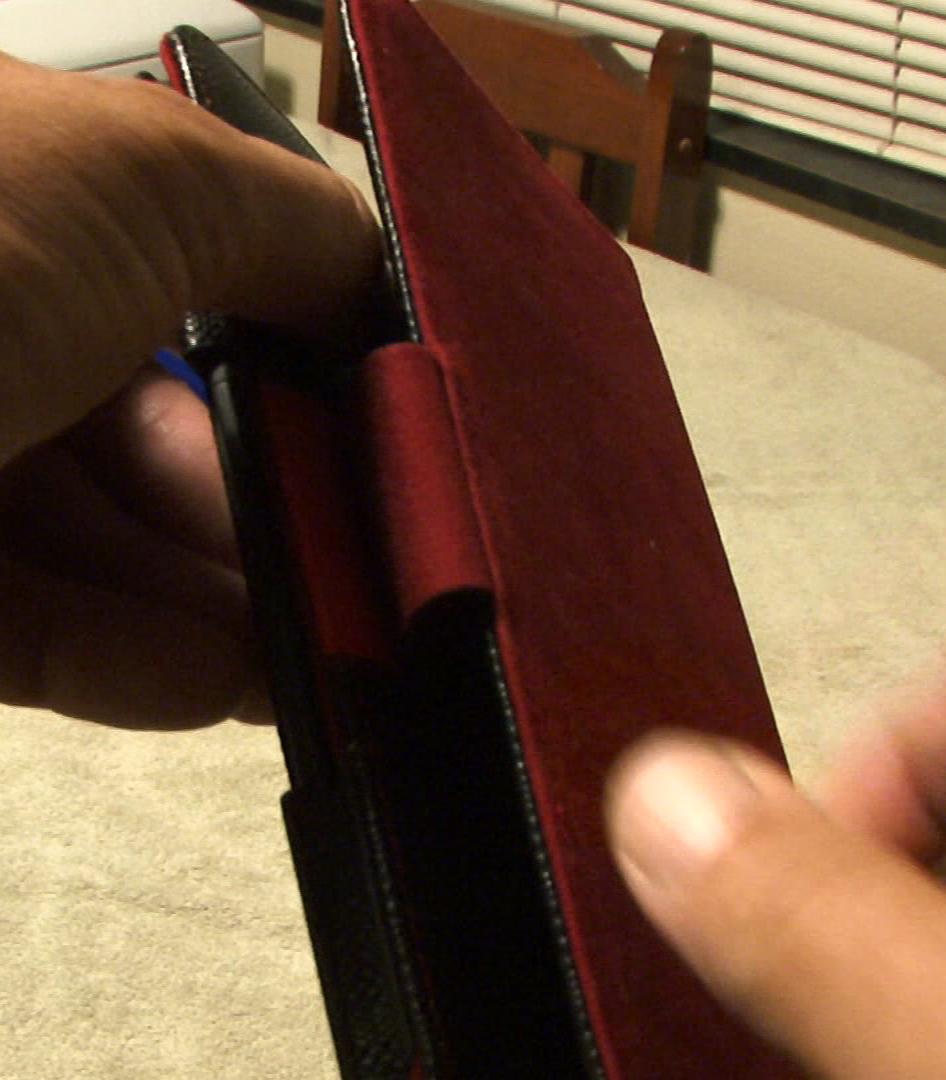
The inside is covered with a beautiful soft velvet in your choice of red or purple.


If there was any glue used on the case, I’ve not been able to spot it. Everything I see is well stitched together.


There’s also a convenient strap to carry the case with. It’s made of the same polyurethane leather and is easily detachable if not needed. The case is secured by a tab that slides under a loop on the rear of the case.


If you want to fold the case in half while reading, you can attach the tab backwards through that same loop on the back of the case to keep it from flapping around.


Your Kindle will slide into the straps snug and secure with no danger of falling out. And the design allows you full access to all the Kindle’s controls. Once you’ve placed the Kindle in this case, it’s unlikely you’ll ever have a reason to remove it. It’s as snug as a bug in a rug!


As well-made as the case is, the light may even be better. The machining on this light is as good as it gets with every part well-seated.


It sports a single white light LED (daylight temperature) which is very easy on the eyes. There’s also a diffuser to aid in getting rid of glare.


It uses 3 AG13 1.5V Button Cell Batteries. These are rated at no less than 25-hours of use and are very economical. You can buy them in packs of ten for less than a quarter each and in packs of fifty for about a dime.


You can keep the light in a drawer if you don’t use it much, but the case also has an elastic band for storing the light. There’s even a small hole to allow for easy access to the light’s on/off button.


I did find myself accidentally turning the light off and on with the case folding in half while reading since this makes the button stick right out into your hand; however, you’ll be glad to know that you can simply turn the light so that the button is pointing elsewhere with no problem. In fact, you can just as easily press the button through the fabric holding it in place, so there’s really no problem at all in this regard.


You may even find that there’s no need to ever remove the light from its elastic holding strap. The base of the light is magnetic, and there’s a magnet on the upper right corner of the case to hold it while reading.


However, I found that keeping the light in its holder, and then bending the gooseneck to the side, provided excellent illumination, perhaps even better than when placed on the magnetic holder.


That flexible gooseneck is what really sets this light apart from most others in the e-reader marketplace. You can easily find a position which illuminates the entire screen evenly. You may recall from my review of Amazon’s own lighted case that getting even light distribution was a major problem with theirs because the bottom half of the screen got very little light in comparison to the upper half.

My photo here doesn’t do the light justice as I couldn’t manage to photograph it in such a way that shows even light distribution, but believe me, you can do it.


Conclusions:

Don’t get me wrong, although it's close, no one has yet to come out with the perfect lighted e-reader case. My only complaint with this one is that, while the light is sufficient, it could be a bit stronger. I’ve always believed that the best way to attack the problem is to have a case with 4-LEDs, one in each corner of the screen. I’m confident that eventually we’ll see that case appear. But at the moment, this offering from SD Tabletwear may just be the one to beat, especially considering the low price, high quality materials, great workmanship, and an adequate LED light on a gooseneck for easy positioning. My sister wants a Kindle for her birthday, and I intend to give her one of my two lighted cases to go with it. Guess which one I’ll be keeping.

Friday, August 26, 2011

The Mighty Manly Dash

Here's a little discussed topic of interest. Men just love to write with lots and lots of dashes—. Women avoid using, or even reading, dashes if they can, as if to say, "Hark! what manner of hellish fiend poketh forth at me?"

Why do men use dashes so much? Probably because a dash implies a forcefulness that other punctuation types—except for the exclamation point—do not! And you know us men; we're all about domineering!

We mostly use em dashes in the USA. Style manuals (the evil beasts!) do generally have specific rules when using en – verses em — dashes, but I find more often than not that most people dispose of those nasty rules and simply use em dashes and hyphens for everything, the main reason being that the en dash is not much longer than a hyphen - and people often confuse the two while reading. The main use of the en dash was always to indicate a range between two things such as months or years. Thus April–June means from April to (or through) June. However, many people do indeed use a hyphen for this: April - June. They generally will place spaces around the hyphen when doing so, but some people don't bother: April-June, and we all know what they mean just the same. Most word processors don't have a keyboard character for either the en or em dash, and this is probably the reason why people have largely dropped the en dash in favor of the hyphen nowadays. Word processors do, however, generally have an insert function for dashes, meaning that you can choose a dash from some kind of "insert" drop down menu where you can choose to insert a "special character" such as a dash. MS-Word has a great feature for inserting em dashes automatically, although you may have to turn it on in "options". If this is turned on, then you merely need to type two hyphens in a row --, and they will automatically be turned into a single em dash —. Pretty nifty, eh? Of course my version of Word is fourteen years old, so yours may treat em dashes differently.

Now, what can a dash do? I'm glad you asked, my punctuation starved friend. There are many things it can do, but the greatest among these is that it can replace many other kinds of punctuation, thereby making the chore of writing less of a chore. And what man isn't in favor of less chores? I can nearly always tell a man's writing from a woman's because women will inevitably look for the hardest way to say something, both stylistically and grammatically, that they can. Thus their papers are full of commas, colons, ellipses, and parentheses when a simple em dash could often be used in their stead. Now any fool knows that you need to use some variety when writing, so I'm obviously not saying that you should always use a dash in place of these other punctuation marks. But men do tend to use dashes quite a bit while women ignore everything about them.

The thing that need be remembered about the mighty dash is that it is indeed mighty! It's often used to set off a thought in the middle of a sentence just as a parenthesis would, but when a dash is used, it generally has a forcefulness about. It almost causes you to see exclamation marks even when they aren't present. For example:

Ron Paul is running for president yet again—the whacko—much to the chagrin of sane republicans.

See what I mean? Women tend to tip-toe around controversy though and would rather whisper their snide remarks:

Ron Paul is running for president yet again (the whacko) much to the chagrin of sane republicans.

It's almost as if the clause inside the parenthesis is the writer whispering in your ear.

It's the same when using a dash in place of a colon. A colon is the sissy version of a dash. It's a suggestion. A dash is a command! Let's say we're leaving a note for our son on the fridge:

Bobby, before you leave the house today, you have a few chores: clean your room; mow the lawn; and practice your trumpet lesson.

Bobby, before you leave the house today, you have a few chores—clean your room; mow the lawn; and practice your trumpet lesson.

In this case it's kind of subtle, but I think you can still see where the dash makes the list of chores more forceful.

Where the forcefulness of the dash really shines though is near the end of a sentence when setting off a phrase:

He was a great American—in his own mind.

Or:

She thought she could resist my good looks and charm—foolish girl.

And lastly, though many people frown on it, a dash can be used to show a thought trailing off at the end of a sentence:

I was left for dead, and nearly did give up on living, until I thought of him living it up on my dime, so—.

This last example is one in which I have never once come upon a piece of writing by a woman where she used a dash. (The lesser sex will use an ellipsis every time—shhh.)

Thursday, June 16, 2011

Literary Fiction Is An Invalid Genre

I found this on the internet somewhere or another a while back and copied it. Here I will lay out several objections:

Great Literature and literary fiction are not necessarily the same thing. Shakespeare's work, while certainly great literature, was genre material produced for general consumption. Both general and literary fiction can find its way into canon; what distinguishes literary fiction is not so much quality or endurance, but idiosyncrasy.


General fiction relies on convention: structured plot, near-journalistic (or alternately, florid) prose, easily recognized character relationships, and typically a third-person omniscient or roving third-person limited perspective. Literary fiction may discard an advancing plot (The Sound and the Fury), specific characters (If on a Winter's Night a Traveler) or even spelling and syntax (Finnegan's Wake), operating by its own rules. It requires more effort of interpretation from the reader, but it can convey thought-structures beyond the means of conventional storytelling.


Most other people don't have a definition of literary fiction, but just a vague sense that it's something like a classic, or that it uses lots of big words, or that it's anything that doesn't fit another category. Do you object to either my description of the qualities of general fiction, my description of the qualities of literary fiction, or the distinctions I've drawn between the two? If so, on what grounds?


I've read a considerable amount of literary fiction, classics, general fiction, and genre fiction, as well as having been exposed to a great deal of fiction aspiring to be literary and received instruction on the qualities of literary fiction, in the course of pursuing a Bachelor's Degree of Fine Arts in the English Language. My opinion is certainly not authoritative, but being conversant in all the sorts of literature under discussion and having intimate knowledge of literary fiction, those who read it, and those who produce it, I'm confident those last two groups of people, at least, would assent to most or all of my description.

"Literary fiction may discard an advancing plot..., specific characters..."

So may genre fiction. A great example would be any of the myriad stories that take place within dreams, and more specifically, stories that leave you wondering if what you just read was a psychological event; a spiritual event; or a material world event based on the science of many worlds, parallel universes, and hidden dimensions. You'll find most of these in the fantasy and science fiction categories.

"...or even spelling and syntax... operating by its own rules."

Many genre specific stories do the same, or would anyone really not consider Lord of the Rings to be fantasy? And Tolkien was not alone when it came to making-up his own language.

"It requires more effort of interpretation from the reader."

This is generally only true because these authors do their very best to use the most obscure and uncommon words they can find. They dig up old lost and forgotten words more often than not, and do so for all the wrong reasons. Why would I use a word like "threadbare" in this day and age when almost no one under thirty would know what it meant? when I can be more effective by speaking in modern language and say "wearing thin" or "getting old" etc. Most authors that get pegged with the LF tag are simply poor communicators who come off sounding like a 12-year old trying to impress their English teacher and failing miserably at it. The one and only reason to use uncommon and obscure words is if they are the only ones available to convey the meaning you need. I fully expect to come upon obscurity when reading something like Chris Langan's Cognitive Theoretical Model of the Universe where he had to actually invent terms where none existed to convey his thoughts. The same would have been true during the fifties when David Bohm was inventing new concepts like nonlocality and quantum potential. I also expect to see uncommon terms when reading good sci-fi. (I don't think I ever read an Author C. Clarke novel without learning some new ones.) This simply isn't the case with hardly any literary fiction I know of. Their obscurity is generally just bad writing.

"...but it can convey thought-structures beyond the means of conventional storytelling."

Name one that I can't find the equivalent of in a genre category.

"Most other people don't have a definition of literary fiction, but just a vague sense...."

That's because it doesn't have one except that of being very focussed on words even at the expense of the story. LF is by its very nature incredibly subjective, and most people realize that.

Where most LF authors miss the boat is that they tend to concern themselves more with these uncommon and obscure words as a way of making themselves appear smarter than they really are. But this isn't what happens. Most readers will simply be irritated because they realize they're reading an author who has a thesaurus open in front of them. They come off sounding more like precocious children than adults. What they should be concerned with is learning to turn a phrase. That, along with having good stories, is exactly what makes a great author a great author. Few were better at it than Mark Twain and GK Chesterton. Consider Twain's describing a child's birthday party as a "pleasant turmoil." No uncommon or obscure words there. Good authors don't need them. Take any number of quotes from Chesterton:

"The true soldier fights not because he hates what is in front of him, but because he loves what is behind him."

"...feminism is mixed up with a muddled idea that women are free when they serve their employers but slaves when they help their husbands."

"It is absurd for the Evolutionist to complain that it is unthinkable for an admittedly unthinkable God to make everything out of nothing, and then pretend that it is more thinkable that nothing should turn itself into everything."

"Impartiality is a pompous name for indifference which is an elegant name for ignorance."

Or how about Ray Chandler:

"To say goodbye is to die a little."

Uncommon and obscure words are almost always an excuse for a lack of talent, and this is exactly why LF doesn't sell. Not because people don't understand it, but because they do.

"I've read a considerable amount of literary fiction, classics, general fiction, and genre fiction, as well as having been exposed to a great deal of fiction aspiring to be literary and received instruction on the qualities of literary fiction, in the course of pursuing a Bachelor's Degree of Fine Arts in the English Language."

Hmm—well:

"Without education, we are in a horrible and deadly danger of taking educated people seriously." ~ GK Chesterton

Tuesday, June 14, 2011

Review: A Canticle for Leibowitz by Walter Miller

Canticle is a futuristic tale about the world rebuilding itself after a nuclear world war that took place in our time. The novel is in three stages about a thousand years apart. (I've heard it described as three novellas, but I don't know if that's strictly true). After the war, people go on a killing and burning spree where they try to wipe out anything and everything that has to do with technology, including all the books. They think technology caused the problem and want to go back to the way people lived prior to the industrial age. The Catholic Church secretly disagrees, so the priests and monks covertly conduct archeological digs trying to find any books or papers or fragments that survived the war, and they store them in hidden locations. Leibowitz was an electrical engineer before and during the war. After the war, he became a monk and helped to search for books, but he was killed and became a martyr, so later an order of Monks was named after him. Little by little, as bits and pieces of books are examined, the monks and priests, along with some teachers, eventually figure out how to make an electric light using a human powered generator. By the book's final stage, it's beginning to look as though the world may finally get back to where it was before the war a few thousand years earlier. The big question becomes one of, will history repeat itself? There are many philosophical queries into morality along the way, the most significant having to do with suicide in the face of terrible suffering.

As a side note, the author himself committed suicide before finishing the book's sequel. When you learn about the author's life, his lifelong bout with depression, his WWII combat service along with the bombing of a famous European Cathedral that his own plane brought down, his conversion to Catholicism after the war, and his subsequent crises of faith—you'll soon find yourself immersed in a second real life story even more puzzling and tragic than anything you'll find in the book.

This also just happens to be one of the best written books I've ever come across. Miller knew how to write for men. There are very few wasted words and no needless descriptions.